Difference between revisions of "Races"
From Harath Rules
(→Broos) |
(→Intro) |
||
| (12 intermediate revisions by the same user not shown) | |||
| Line 1: | Line 1: | ||
==Intro== | |||
In Harath, there are eleven main character races: Broos, Centaurs, Dwarfs, Elves, Gnomes, Halflings, Humans, Ogres, Orcs, Trolls, and Winged Men. The rules are written using humans as the "average" race. No racial modifiers apply to humans. If you choose to play a character that is not human, certain racial modifiers automatically apply to your character. In addition, with GM permission, you can play any race you can dream up. For any race not listed here, you and the GM will have to agree on the racial modifiers that apply. | In Harath, there are eleven main character races: Broos, Centaurs, Dwarfs, Elves, Gnomes, Halflings, Humans, Ogres, Orcs, Trolls, and Winged Men. The rules are written using humans as the "average" race. No racial modifiers apply to humans. If you choose to play a character that is not human, certain racial modifiers automatically apply to your character. In addition, with GM permission, you can play any race you can dream up. For any race not listed here, you and the GM will have to agree on the racial modifiers that apply. | ||
Numbers in parentheses indicate the specific racial modifiers that apply. Here's how to interpret them: | Numbers in parentheses indicate the specific racial modifiers that apply. Here's how to interpret them: | ||
For Attributes, Abilities, and Disabilities, the number modifies the level you obtain using CP. | |||
<blockquote>Example: You use 10 CP to get Str=4, but your halfling's racial modifier is Str (-2), so you will actually play at Str=2. If you want your halfling to play at Str=4, you must use 21 CP to get Str=6. Conversely, your winged folk character has Str (+2), so if you use 10 CP to get Str=4, you will play at Str=6.</blockquote> | |||
For Secondary Statistics that you simply select, the number indicates the race's average statistic. | |||
<blockquote>Example: Ogres have Hgt (+3), meaning that the average ogre is 3 taller than the average human. Since the human average Hgt=18, the average ogre Hgt=21.</blockquote> | |||
For secondary Statistics that you derive from the character’s Attributes, calculate the statistic in the usual way, then include the modifier. | |||
<blockquote>Example: You have Quick=5 and Dex=7, so your Reaction speed is 6. However, your gnome has Reaction (-1), so you will play with R=4.</blockquote> | |||
For Skills, the numbers indicate that the race automatically gets that level of the Skill without using CP to get it. You can purchase additional levels as if starting from level 1. | |||
<blockquote>Example: Centaurs have a racial modifier of Musical Ability (2). If you play a centaur, you need not pay any CP to get a Musical Ability=2. If you want your character to have Musical Ability=4, you only need to use 3 CP to get the additional 2 levels (that is, treat the CP expenditure as if you were getting levels 1 and 2, not levels 3 and 4, which would have expended 7 CP).</blockquote> | |||
< | |||
[[Reaction Rolls|Reaction]] is a reflection of how well one person likes another on first meeting. The Reaction roll modifiers in this section indicate the relative feelings of humans toward each particular race. The chart at the bottom of the page provides information on how various races view each other, in general. For simplicity, the assumption that races view each other similarly - that is, if humans have R=(-6) towards broos, assume that broos similarly have a -6 toward humans. | [[Reaction Rolls|Reaction]] is a reflection of how well one person likes another on first meeting. The Reaction roll modifiers in this section indicate the relative feelings of humans toward each particular race. The chart at the bottom of the page provides information on how various races view each other, in general. For simplicity, the assumption that races view each other similarly - that is, if humans have R=(-6) towards broos, assume that broos similarly have a -6 toward humans. | ||
| Line 17: | Line 18: | ||
==Broos== | ==Broos== | ||
{| style="float: | {| style="float:left; width:200px;" | ||
| https://raw.githubusercontent.com/sschra01/sschra01.github.io/main/broo.webp?.png | | https://raw.githubusercontent.com/sschra01/sschra01.github.io/main/broo.webp?.png | ||
|} | |} | ||
| Line 29: | Line 30: | ||
==Centaurs== | ==Centaurs== | ||
{| style="float:right; width:200px;" | |||
| https://raw.githubusercontent.com/sschra01/sschra01.github.io/main/Centaur.webp?.png | |||
|} | |||
Centaurs seem to be a combination of human and horse, with sleek, equine bodies and a tremendously strong human torso from the waist up where a horse’s neck and head would be. Overall, they stand a good foot taller than the average human, though they do not live quite as long. They live in large tribes in tundras, steppes, and northern grasslands. Although centaur tribes used to seasonally migrate, most have given up this practice in favor of living a more settled lifestyle. Centaurs are strong, noble creatures that believe they are superior to all other sentient beings. Because of this, they are very intolerant of “inferior” races, an attitude that causes them to be in continual conflict (both armed and unarmed) with most other races, who find them to be fierce warriors. Needless to say, they have a bad reputation amongst other sentient races. However, if you do find yourself in the rare position of being on the good side of a centaur, you have a steadfast friend for life. Centaurs love of music and freedom. | Centaurs seem to be a combination of human and horse, with sleek, equine bodies and a tremendously strong human torso from the waist up where a horse’s neck and head would be. Overall, they stand a good foot taller than the average human, though they do not live quite as long. They live in large tribes in tundras, steppes, and northern grasslands. Although centaur tribes used to seasonally migrate, most have given up this practice in favor of living a more settled lifestyle. Centaurs are strong, noble creatures that believe they are superior to all other sentient beings. Because of this, they are very intolerant of “inferior” races, an attitude that causes them to be in continual conflict (both armed and unarmed) with most other races, who find them to be fierce warriors. Needless to say, they have a bad reputation amongst other sentient races. However, if you do find yourself in the rare position of being on the good side of a centaur, you have a steadfast friend for life. Centaurs love of music and freedom. | ||
| Line 39: | Line 42: | ||
==Dwarves== | ==Dwarves== | ||
{| style="float:left; width:200px;" | |||
| https://raw.githubusercontent.com/sschra01/sschra01.github.io/main/dwarf.webp?.png | |||
|} | |||
Dwarves are short and muscular, incredibly strong and tenacious. They are dark-skinned and prefer to wear elaborate beards and sturdy leather clothing. Their extreme hardiness allows them to live for an average of 100 years, and they tend to spend that time working hard and enjoying the toil of life. They normally live underground due to their overriding fondness for things of the earth, where they primarily mine all manner of jewels, gems, and metals, precious and otherwise, from which they smith and craft items of overwhelming beauty that they trade with other civilizations to obtain whatever goods they cannot make for themselves. Despite this reliance on trade, they distrust “surface dwellers”, and prefer to limit such contact as much as possible. | Dwarves are short and muscular, incredibly strong and tenacious. They are dark-skinned and prefer to wear elaborate beards and sturdy leather clothing. Their extreme hardiness allows them to live for an average of 100 years, and they tend to spend that time working hard and enjoying the toil of life. They normally live underground due to their overriding fondness for things of the earth, where they primarily mine all manner of jewels, gems, and metals, precious and otherwise, from which they smith and craft items of overwhelming beauty that they trade with other civilizations to obtain whatever goods they cannot make for themselves. Despite this reliance on trade, they distrust “surface dwellers”, and prefer to limit such contact as much as possible. | ||
| Line 49: | Line 54: | ||
==Gnomes== | ==Gnomes== | ||
{| style="float:right; width:200px;" | |||
| https://raw.githubusercontent.com/sschra01/sschra01.github.io/main/gnome.webp?.png | |||
|} | |||
Gnomes are shorter, slenderer, and fairer than their cousins, the dwarves. Their skin color ranges from dark tan to woody brown, their hair is fair, and their eyes can be any shade of blue. The males prefer short, carefully trimmed beards, and all generally wear leather or earth tones, decorated with intricate stitching or fine jewelry. Many gnomish populates remain underground, where all gnomes used to live, usually not very far from dwarven strongholds. These days, however, more and more tribes are moving to the surface, in above-ground villages very similar to halfling dwellings. Even so, they prefer to keep themselves to themselves, and limit contact with other races. When they must interact, they prefer to do it with dwarves and halflings. Most gnomes who travel outside gnome lands are traders, tinkers, or warriors. | Gnomes are shorter, slenderer, and fairer than their cousins, the dwarves. Their skin color ranges from dark tan to woody brown, their hair is fair, and their eyes can be any shade of blue. The males prefer short, carefully trimmed beards, and all generally wear leather or earth tones, decorated with intricate stitching or fine jewelry. Many gnomish populates remain underground, where all gnomes used to live, usually not very far from dwarven strongholds. These days, however, more and more tribes are moving to the surface, in above-ground villages very similar to halfling dwellings. Even so, they prefer to keep themselves to themselves, and limit contact with other races. When they must interact, they prefer to do it with dwarves and halflings. Most gnomes who travel outside gnome lands are traders, tinkers, or warriors. | ||
| Line 59: | Line 66: | ||
==Elves== | ==Elves== | ||
{| style="float:left; width:200px;" | |||
| https://raw.githubusercontent.com/sschra01/sschra01.github.io/main/elf.webp?.png | |||
|} | |||
Elves are a tall, thin, joyful folk, fair of face and frivolous in their outlook on life. They are known for their keen eyesight. Of all the sentient races, they have the longest lifespan, which they prefer to spend in artistic pursuits to the greatest extent possible. They prefer to live in or near forests, in villages that so closely resemble their natural surroundings that one could easily miss them entirely, if the continuous singing and playing of musical instruments did not draw one’s attention. Elves never take life too seriously, rarely planning for the future, living in the moment and embracing spur of the moment decisions. In many ways, they are polar opposites to dwarves. Stories of the mutual elf/dwarf disdain are not exaggerated. | Elves are a tall, thin, joyful folk, fair of face and frivolous in their outlook on life. They are known for their keen eyesight. Of all the sentient races, they have the longest lifespan, which they prefer to spend in artistic pursuits to the greatest extent possible. They prefer to live in or near forests, in villages that so closely resemble their natural surroundings that one could easily miss them entirely, if the continuous singing and playing of musical instruments did not draw one’s attention. Elves never take life too seriously, rarely planning for the future, living in the moment and embracing spur of the moment decisions. In many ways, they are polar opposites to dwarves. Stories of the mutual elf/dwarf disdain are not exaggerated. | ||
| Line 70: | Line 79: | ||
==Halflings== | ==Halflings== | ||
{| style="float:right; width:200px;" | |||
| https://raw.githubusercontent.com/sschra01/sschra01.github.io/main/halfling.webp?.png | |||
|} | |||
As their nickname implies, “Halflings” (or “Hobbits” as they call themselves) stand only about half as tall as humans, though their lifestyle often leads them to carry an excess of weight. Despite this, they can be deceptively quick when they want to be. Although small and overweight as a rule, Halflings live in just about every climate, in villages clustered in circular patterns. Although the majority of their structures exist above ground, they do take advantage of the earth’s natural temperature control by digging their sleeping quarters underground. Most humans view halflings as a lazy people, although the races live together in relative peace. In fact, Hobbits are a very peaceful race that prefers to live in harmony with all living creatures. They very much prefer the more relaxed aspects of life – eating, sleeping, watching the days go by. | As their nickname implies, “Halflings” (or “Hobbits” as they call themselves) stand only about half as tall as humans, though their lifestyle often leads them to carry an excess of weight. Despite this, they can be deceptively quick when they want to be. Although small and overweight as a rule, Halflings live in just about every climate, in villages clustered in circular patterns. Although the majority of their structures exist above ground, they do take advantage of the earth’s natural temperature control by digging their sleeping quarters underground. Most humans view halflings as a lazy people, although the races live together in relative peace. In fact, Hobbits are a very peaceful race that prefers to live in harmony with all living creatures. They very much prefer the more relaxed aspects of life – eating, sleeping, watching the days go by. | ||
| Line 80: | Line 91: | ||
==Ogres== | ==Ogres== | ||
{| style="float:right; width:200px;" | |||
| https://raw.githubusercontent.com/sschra01/sschra01.github.io/main/Ogre.webp?.png | |||
|} | |||
Ogres are tall, powerful, fierce and tough. Their squat heads and “attack first and ask questions later” attitude lead people to believe they are stupid, but they are actually just as intelligent as humans. Ogres are believed to have a very short natural lifespan, though it is actually uncertain, as their lifestyle usually prevents them from dying of natural causes. They tend to live underground caverns accessed through remote and inhospitable terrain such as tall mountains or deep crevasses. Their diet almost exclusively includes uncooked flesh. There is no kind of meat they will not eat, including ogre flesh, but they prize elvish, winged folk, and human flesh above all others. This preference, as you may well imagine, makes them very unpopular amongst non-ogre populations. As a result, ogres go to great lengths to disguise themselves (usually as half-giants, or similarly large sentient creatures) to prevent detection. | Ogres are tall, powerful, fierce and tough. Their squat heads and “attack first and ask questions later” attitude lead people to believe they are stupid, but they are actually just as intelligent as humans. Ogres are believed to have a very short natural lifespan, though it is actually uncertain, as their lifestyle usually prevents them from dying of natural causes. They tend to live underground caverns accessed through remote and inhospitable terrain such as tall mountains or deep crevasses. Their diet almost exclusively includes uncooked flesh. There is no kind of meat they will not eat, including ogre flesh, but they prize elvish, winged folk, and human flesh above all others. This preference, as you may well imagine, makes them very unpopular amongst non-ogre populations. As a result, ogres go to great lengths to disguise themselves (usually as half-giants, or similarly large sentient creatures) to prevent detection. | ||
| Line 90: | Line 103: | ||
==Orcs== | ==Orcs== | ||
{| style="float:left; width:200px;" | |||
| https://raw.githubusercontent.com/sschra01/sschra01.github.io/main/orc.webp?.png | |||
|} | |||
Orcs are swarthy, aggressive creatures about the same size as human, but their stooped and bowlegged posture means they are actually somewhat shorter that humans. They can occasionally be found living in isolated communities far from other sentient beings, but are much more likely to be encountered as enslaved by some of the larger demi-human races, such as hobgoblins, bugbears, gnolls, etc. They are crude, crass, boorish, and devoid of any redeeming value, at least from a human standpoint. They are dirty, disease-ridden, and eat anything, including other orcs. They love to dominate weaker creatures, but are themselves fairly readily dominated. They tend to be physically strong, but are weak-willed fighters. They are willing soldiers, but to field an orc army without non-orc leaders is to be routed at the earliest opportunity. | Orcs are swarthy, aggressive creatures about the same size as human, but their stooped and bowlegged posture means they are actually somewhat shorter that humans. They can occasionally be found living in isolated communities far from other sentient beings, but are much more likely to be encountered as enslaved by some of the larger demi-human races, such as hobgoblins, bugbears, gnolls, etc. They are crude, crass, boorish, and devoid of any redeeming value, at least from a human standpoint. They are dirty, disease-ridden, and eat anything, including other orcs. They love to dominate weaker creatures, but are themselves fairly readily dominated. They tend to be physically strong, but are weak-willed fighters. They are willing soldiers, but to field an orc army without non-orc leaders is to be routed at the earliest opportunity. | ||
| Line 100: | Line 115: | ||
==Trolls== | ==Trolls== | ||
{| style="float:right; width:200px;" | |||
| https://raw.githubusercontent.com/sschra01/sschra01.github.io/main/troll.webp?.png | |||
|} | |||
Trolls are tall, rangy creatures who are terribly strong. They are very tough to kill, which has given rise to the rumor that they can regenerate, but this is simply not true. They are fiercely protective of their territory, which includes both their dark, underground lairs, where they live in small family groups and the hunting grounds that provide meals for their families. Hunting is vital to the trolls’ welfare, as they subsist almost entirely on mean, preferring uncooked animals. They do not generally eat humanoids, but will if given an opportunity – they never turn down an easy meal. If they have one positive aspect, it is that they have never been known to eat other trolls. | Trolls are tall, rangy creatures who are terribly strong. They are very tough to kill, which has given rise to the rumor that they can regenerate, but this is simply not true. They are fiercely protective of their territory, which includes both their dark, underground lairs, where they live in small family groups and the hunting grounds that provide meals for their families. Hunting is vital to the trolls’ welfare, as they subsist almost entirely on mean, preferring uncooked animals. They do not generally eat humanoids, but will if given an opportunity – they never turn down an easy meal. If they have one positive aspect, it is that they have never been known to eat other trolls. | ||
| Line 110: | Line 127: | ||
==Winged Folk== | ==Winged Folk== | ||
{| style="float:right; width:200px;" | |||
| https://raw.githubusercontent.com/sschra01/sschra01.github.io/main/WingedFolk.webp?.png | |||
|} | |||
Winged folk (or “Aerans” as they style themselves) are human in appearance, with the exceptions of their thinness and the gigantic wings on their back. They enjoy wide-open spaces, making their homes on the remotest of high mountain pains and spending their days in the skies above them. Their personalities are a mix of human and elf. They enjoy living their life, but do not approach it as frivolously as elves do. They are rarely seen near populated areas, leading many city dwellers to believe the Winged Folk to be nothing more than a myth. Many such doubters who have seen them have claimed them to be angels or devils, rather than members of a sentient humanoid race. | Winged folk (or “Aerans” as they style themselves) are human in appearance, with the exceptions of their thinness and the gigantic wings on their back. They enjoy wide-open spaces, making their homes on the remotest of high mountain pains and spending their days in the skies above them. Their personalities are a mix of human and elf. They enjoy living their life, but do not approach it as frivolously as elves do. They are rarely seen near populated areas, leading many city dwellers to believe the Winged Folk to be nothing more than a myth. Many such doubters who have seen them have claimed them to be angels or devils, rather than members of a sentient humanoid race. | ||
| Line 121: | Line 140: | ||
==Inter-Racial Reaction Modifiers== | ==Inter-Racial Reaction Modifiers== | ||
{| class="wikitable" style="width:600px" | |||
{| class=" | |||
! !!Centaurs !! Dwarfs !! Elves !! Gnomes !! Halflings !! Ogres !! Orcs !! Trolls !! Winged Folk | ! !!Centaurs !! Dwarfs !! Elves !! Gnomes !! Halflings !! Ogres !! Orcs !! Trolls !! Winged Folk | ||
|- | |- | ||
| Line 133: | Line 151: | ||
| Elves || || || || -4 || -1 || -6 || -3 || -4 || -2 | | Elves || || || || -4 || -1 || -6 || -3 || -4 || -2 | ||
|- | |- | ||
| Gnomes || || || || || 0 || -2 || -2 || -2 || -5 | | Gnomes || || || || || 0 || -2 || -2 || -2 || -5 | ||
|- | |- | ||
| Halflings || || || || || || -2 || -2 || -1 || 0 | | Halflings || || || || || || -2 || -2 || -1 || 0 | ||
Latest revision as of 01:30, 1 March 2021
Intro
In Harath, there are eleven main character races: Broos, Centaurs, Dwarfs, Elves, Gnomes, Halflings, Humans, Ogres, Orcs, Trolls, and Winged Men. The rules are written using humans as the "average" race. No racial modifiers apply to humans. If you choose to play a character that is not human, certain racial modifiers automatically apply to your character. In addition, with GM permission, you can play any race you can dream up. For any race not listed here, you and the GM will have to agree on the racial modifiers that apply.
Numbers in parentheses indicate the specific racial modifiers that apply. Here's how to interpret them: For Attributes, Abilities, and Disabilities, the number modifies the level you obtain using CP.
Example: You use 10 CP to get Str=4, but your halfling's racial modifier is Str (-2), so you will actually play at Str=2. If you want your halfling to play at Str=4, you must use 21 CP to get Str=6. Conversely, your winged folk character has Str (+2), so if you use 10 CP to get Str=4, you will play at Str=6.
For Secondary Statistics that you simply select, the number indicates the race's average statistic.
Example: Ogres have Hgt (+3), meaning that the average ogre is 3 taller than the average human. Since the human average Hgt=18, the average ogre Hgt=21.
For secondary Statistics that you derive from the character’s Attributes, calculate the statistic in the usual way, then include the modifier.
Example: You have Quick=5 and Dex=7, so your Reaction speed is 6. However, your gnome has Reaction (-1), so you will play with R=4.
For Skills, the numbers indicate that the race automatically gets that level of the Skill without using CP to get it. You can purchase additional levels as if starting from level 1.
Example: Centaurs have a racial modifier of Musical Ability (2). If you play a centaur, you need not pay any CP to get a Musical Ability=2. If you want your character to have Musical Ability=4, you only need to use 3 CP to get the additional 2 levels (that is, treat the CP expenditure as if you were getting levels 1 and 2, not levels 3 and 4, which would have expended 7 CP).
Reaction is a reflection of how well one person likes another on first meeting. The Reaction roll modifiers in this section indicate the relative feelings of humans toward each particular race. The chart at the bottom of the page provides information on how various races view each other, in general. For simplicity, the assumption that races view each other similarly - that is, if humans have R=(-6) towards broos, assume that broos similarly have a -6 toward humans.
Gender
The gender (male or female) of your character is up to you. Since you choose your character’s Hgt, you can select any Hgt you want. There is no significant gameplay difference. That said, in the wider world, the standard female Hgt of any species is generally (-1) from the average male Hgt.
Broos
|
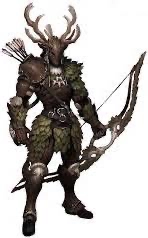
Broos tend to have tall, thin human-like bodies with antelope or deer heads. Starting in young adulthood, they grow antlers, which are shed late in the fall and grow back larger early next spring. They are strong and tough, but are slightly shorter lived than humans. They usually live in woods and grasslands in tribes that migrate seasonally to remain in temperate areas. Broos are foul creatures that never bathe, and though they are invulnerable to many of the diseases that afflict humans, they often carry and spread such diseases. Because of this, as well as their tendency toward violent behavior - especially toward weaker creatures - they are typically shunned in human society.
- Average Primary Statistics: Age (adult=14, max=80), Hgt (20 +antlers), Wgt (16)
- Standard Attribute Modifiers: Str (+2), Con (+1), Mana (-2), Quick (-1)
- Standard Abilities and Disabilities: Disease Resistance (2), Odious Personal Habit – Rubbing dung in hair (3), Poison Resistance (2), Sadism (3)
- Skill Restrictions: None
- Reaction to humans: (-6)
Centaurs
|
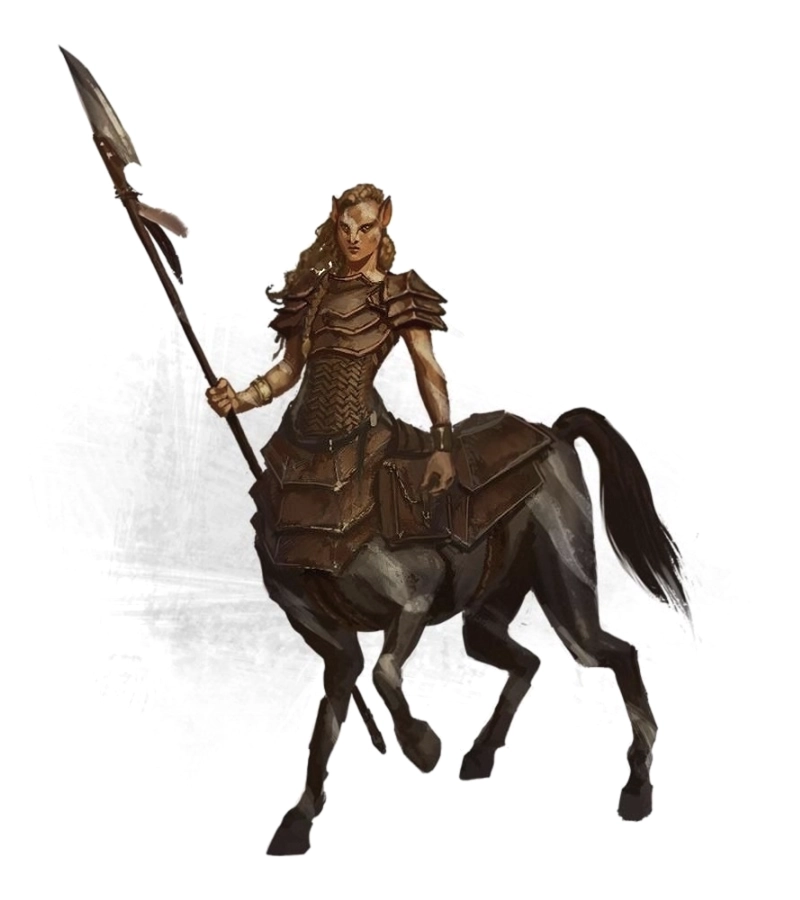
Centaurs seem to be a combination of human and horse, with sleek, equine bodies and a tremendously strong human torso from the waist up where a horse’s neck and head would be. Overall, they stand a good foot taller than the average human, though they do not live quite as long. They live in large tribes in tundras, steppes, and northern grasslands. Although centaur tribes used to seasonally migrate, most have given up this practice in favor of living a more settled lifestyle. Centaurs are strong, noble creatures that believe they are superior to all other sentient beings. Because of this, they are very intolerant of “inferior” races, an attitude that causes them to be in continual conflict (both armed and unarmed) with most other races, who find them to be fierce warriors. Needless to say, they have a bad reputation amongst other sentient races. However, if you do find yourself in the rare position of being on the good side of a centaur, you have a steadfast friend for life. Centaurs love of music and freedom.
- Average Primary Statistics: Age (adult=10, max=60), Hgt (15 to back, 21 to head), Wgt (36)
- Standard Attribute Modifiers: Str (+3), Will (+1), Quick (-2), Mana (-2)
- Standard Abilities and Disabilities: Berserk (3), Intolerance (1), Musical Ability (2), Voice (2)
- Skill Restrictions: None
- Reaction to humans: (-1)
Dwarves
|
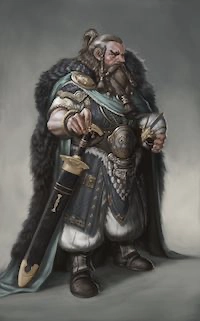
Dwarves are short and muscular, incredibly strong and tenacious. They are dark-skinned and prefer to wear elaborate beards and sturdy leather clothing. Their extreme hardiness allows them to live for an average of 100 years, and they tend to spend that time working hard and enjoying the toil of life. They normally live underground due to their overriding fondness for things of the earth, where they primarily mine all manner of jewels, gems, and metals, precious and otherwise, from which they smith and craft items of overwhelming beauty that they trade with other civilizations to obtain whatever goods they cannot make for themselves. Despite this reliance on trade, they distrust “surface dwellers”, and prefer to limit such contact as much as possible.
- Average Primary Statistics: Age (adult=21, max=125), Hgt (12), Wgt (14)
- Standard Attribute Modifiers: Str (+3), Con (+2), Quick (-2) , Mana (-3)
- Standard Abilities and Disabilities: Intolerance (2), Dark Vision (1), Miserliness (4), Stubbornness (2)
- Skill Restrictions: At least 30% of CP must be placed into metal and/or jewel crafting Skills.
- Reaction to humans: (-3)
Gnomes
|
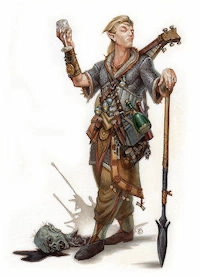
Gnomes are shorter, slenderer, and fairer than their cousins, the dwarves. Their skin color ranges from dark tan to woody brown, their hair is fair, and their eyes can be any shade of blue. The males prefer short, carefully trimmed beards, and all generally wear leather or earth tones, decorated with intricate stitching or fine jewelry. Many gnomish populates remain underground, where all gnomes used to live, usually not very far from dwarven strongholds. These days, however, more and more tribes are moving to the surface, in above-ground villages very similar to halfling dwellings. Even so, they prefer to keep themselves to themselves, and limit contact with other races. When they must interact, they prefer to do it with dwarves and halflings. Most gnomes who travel outside gnome lands are traders, tinkers, or warriors.
- Average Primary Statistics: Age (adult=18, max=110), Hgt (11), Wgt (12)
- Standard Attribute Modifiers: Str (-1), Con (-2), Quick (+1) , Mana (+2)
- Standard Abilities and Disabilities: Intolerance (1), Dark Vision (1), Miserliness (3), Stubbornness (1)
- Skill Restrictions: At least 20% of CP must be placed into sewing and/or jewel crafting Skills.
- Reaction to Humans: (-1)
Elves
|
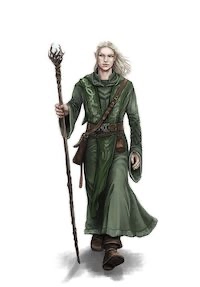
Elves are a tall, thin, joyful folk, fair of face and frivolous in their outlook on life. They are known for their keen eyesight. Of all the sentient races, they have the longest lifespan, which they prefer to spend in artistic pursuits to the greatest extent possible. They prefer to live in or near forests, in villages that so closely resemble their natural surroundings that one could easily miss them entirely, if the continuous singing and playing of musical instruments did not draw one’s attention. Elves never take life too seriously, rarely planning for the future, living in the moment and embracing spur of the moment decisions. In many ways, they are polar opposites to dwarves. Stories of the mutual elf/dwarf disdain are not exaggerated.
- Average Primary Statistics: Age (adult=22, max=130), Hgt (19), Wgt (14)
- Standard Attribute Modifiers: Str (-3), Dex (+2), Mana (-1), Quick (+2)
- Standard Abilities and Disabilities: Intolerance (4), Impulsiveness (2)
- Skill Restrictions: At least 30% of CP must be placed into the arts.
- Skill bonus: Any vision-based roll (+2)
- Reaction to Humans: (-4)
Halflings
|
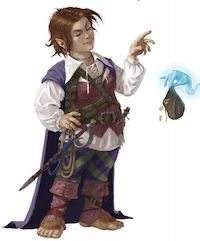
As their nickname implies, “Halflings” (or “Hobbits” as they call themselves) stand only about half as tall as humans, though their lifestyle often leads them to carry an excess of weight. Despite this, they can be deceptively quick when they want to be. Although small and overweight as a rule, Halflings live in just about every climate, in villages clustered in circular patterns. Although the majority of their structures exist above ground, they do take advantage of the earth’s natural temperature control by digging their sleeping quarters underground. Most humans view halflings as a lazy people, although the races live together in relative peace. In fact, Hobbits are a very peaceful race that prefers to live in harmony with all living creatures. They very much prefer the more relaxed aspects of life – eating, sleeping, watching the days go by.
- Average Primary Statistics: Age (adult=17, max=100), Hgt (10), Wgt (14)
- Standard Attribute Modifiers: Str (-2), Con (+2), Dex (+3), Will (-2), Mana (-1)
- Standard Abilities and Disabilities: Animal Empathy (1), Magic Resistance (2), Gluttony (4), Pacifism (4)
- Skill Restrictions: None
- Reaction to Humans: (-2)
Ogres
|
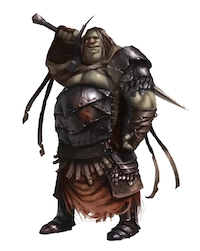
Ogres are tall, powerful, fierce and tough. Their squat heads and “attack first and ask questions later” attitude lead people to believe they are stupid, but they are actually just as intelligent as humans. Ogres are believed to have a very short natural lifespan, though it is actually uncertain, as their lifestyle usually prevents them from dying of natural causes. They tend to live underground caverns accessed through remote and inhospitable terrain such as tall mountains or deep crevasses. Their diet almost exclusively includes uncooked flesh. There is no kind of meat they will not eat, including ogre flesh, but they prize elvish, winged folk, and human flesh above all others. This preference, as you may well imagine, makes them very unpopular amongst non-ogre populations. As a result, ogres go to great lengths to disguise themselves (usually as half-giants, or similarly large sentient creatures) to prevent detection.
- Average Primary Statistics: Age (adult=8, max=45), Hgt (21), Wgt (22)
- Standard Attribute Modifiers: Str (+5), Con (+1), Dex (-1), Mana (-3), Quick (-2)
- Standard Abilities and Disabilities: Deadly Secret (1), Odious Personal Habit – Cannibalism (3), Acute Smell and Taste (2), Acute Vision (2), Dark Vision (1)
- Skill Restrictions: None
- Reaction to Humans: (-6 if known to be an ogre; otherwise, use standard reaction modifier of the race they are using as their disguise)
Orcs
|
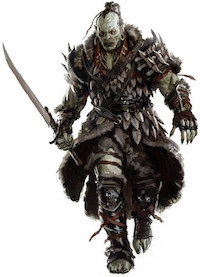
Orcs are swarthy, aggressive creatures about the same size as human, but their stooped and bowlegged posture means they are actually somewhat shorter that humans. They can occasionally be found living in isolated communities far from other sentient beings, but are much more likely to be encountered as enslaved by some of the larger demi-human races, such as hobgoblins, bugbears, gnolls, etc. They are crude, crass, boorish, and devoid of any redeeming value, at least from a human standpoint. They are dirty, disease-ridden, and eat anything, including other orcs. They love to dominate weaker creatures, but are themselves fairly readily dominated. They tend to be physically strong, but are weak-willed fighters. They are willing soldiers, but to field an orc army without non-orc leaders is to be routed at the earliest opportunity.
- Average Primary Statistics: Age (adult=5, max=30), Hgt (16), Wgt (16)
- Standard Attribute Modifiers: Str (+3), Con (+1), Dex (+1), Will (-2), Quick (-3)
- Standard Abilities and Disabilities: Odious Personal Habit – Cannibalism (3), Sadism (3), Bullying (2), Cowardice (4), Dark Vision (1), Toughness (4), Acute Smell and Taste (4)
- Skill Restrictions: None
- Reaction to Humans: (-8)
Trolls
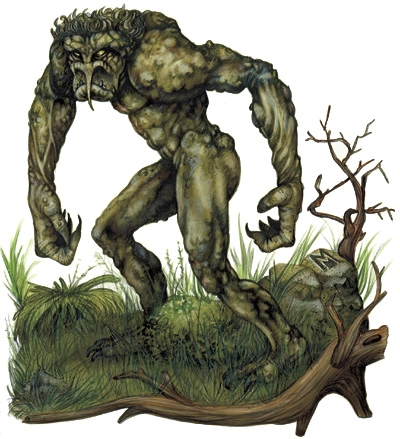
|
Trolls are tall, rangy creatures who are terribly strong. They are very tough to kill, which has given rise to the rumor that they can regenerate, but this is simply not true. They are fiercely protective of their territory, which includes both their dark, underground lairs, where they live in small family groups and the hunting grounds that provide meals for their families. Hunting is vital to the trolls’ welfare, as they subsist almost entirely on mean, preferring uncooked animals. They do not generally eat humanoids, but will if given an opportunity – they never turn down an easy meal. If they have one positive aspect, it is that they have never been known to eat other trolls.
- Average Primary Statistics: Age (adult=11, max=65), Hgt (22), Wgt (20)
- Standard Attribute Modifiers: Str (+4), Dex (+2), Will (-2), Mana (-2), Quick (-2)
- Standard Abilities and Disabilities: Dark Vision (1), Odious Personal Habit – Eating Sentients (3), Acute Smell and Taste (2), High Pain Threshold (4)
- Skill Restrictions: None
- Reaction to Humans: (-7)
Winged Folk
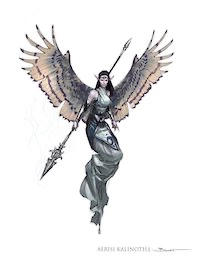
|
Winged folk (or “Aerans” as they style themselves) are human in appearance, with the exceptions of their thinness and the gigantic wings on their back. They enjoy wide-open spaces, making their homes on the remotest of high mountain pains and spending their days in the skies above them. Their personalities are a mix of human and elf. They enjoy living their life, but do not approach it as frivolously as elves do. They are rarely seen near populated areas, leading many city dwellers to believe the Winged Folk to be nothing more than a myth. Many such doubters who have seen them have claimed them to be angels or devils, rather than members of a sentient humanoid race.
- Average Primary Statistics: Age (adult=12, max=70), Hgt (18), Wgt (12)
- Standard Attribute Modifiers: Str (+2), Dex (+2), Will (-1), Mana (-2), Quick (-1)
- Standard Abilities and Disabilities: Absolute Direction (1), Acute Vision (4), Phobia: Claustrophobia (1), Law Abider (3)
- Skill Restrictions: None
- Reaction to Humans: (-2)
Inter-Racial Reaction Modifiers
| Centaurs | Dwarfs | Elves | Gnomes | Halflings | Ogres | Orcs | Trolls | Winged Folk | |
|---|---|---|---|---|---|---|---|---|---|
| Broos | -2 | -2 | -4 | -1 | 0 | -1 | -2 | -1 | -3 |
| Centaurs | -2 | -2 | -1 | -1 | -3 | -4 | -4 | -2 | |
| Dwarves | -5 | 0 | 0 | -3 | -3 | -3 | -6 | ||
| Elves | -4 | -1 | -6 | -3 | -4 | -2 | |||
| Gnomes | 0 | -2 | -2 | -2 | -5 | ||||
| Halflings | -2 | -2 | -1 | 0 | |||||
| Ogres | 0 | -1 | -6 | ||||||
| Orcs | -1 | -4 | |||||||
| Trolls | -5 |