Difference between revisions of "Skills"
From Harath Rules
(→Styles) |
|||
| (22 intermediate revisions by 2 users not shown) | |||
| Line 1: | Line 1: | ||
In Harath, | ==Intro== | ||
In Harath, your character has Skills to show that they have diligently spent time learning and practicing to be good at certain things. You can raise a skill level at a cost of one CP for every level you want to gain. In other words, it takes 8 CP to improve a skill from level 7 to level 8. Unless otherwise stated in the skill description, accomplishing things using your skill requires a TN=4. | |||
However, just because you haven't been trained to use a specific skill doesn't mean you can't give it the old college try. There are two additional ways you can try to do things that require skill rolls: | |||
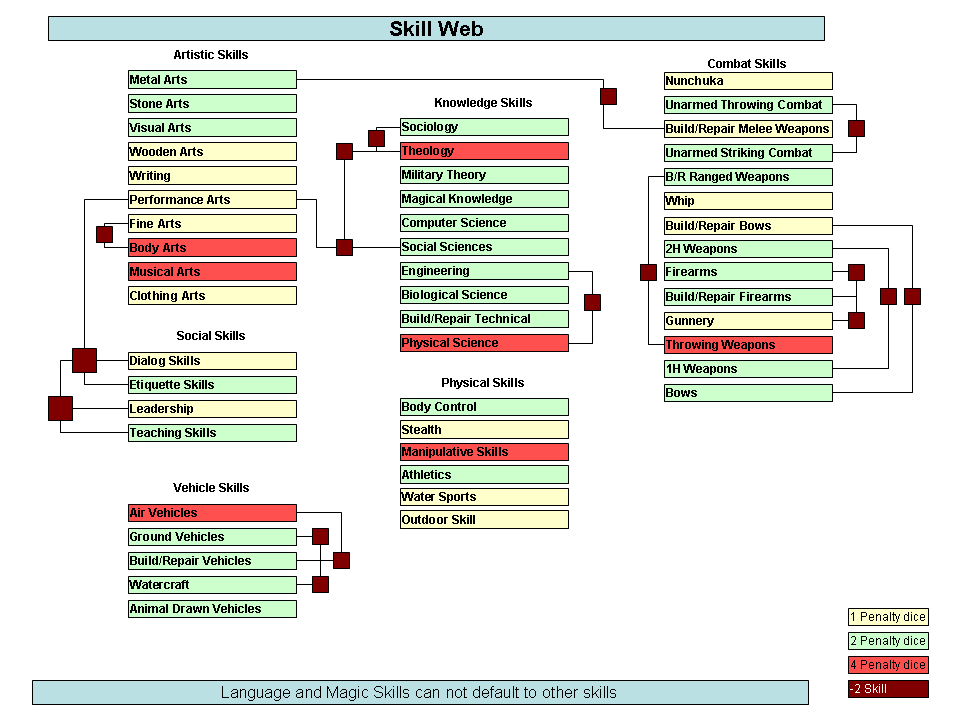
# If you have a similar skill, you can use it (with penalties) in place of the specific skill you don't know. For details, see the Skill Web at the bottom of this page.<p> | |||
# If you don't have any similar skills, well, all still is not lost. Every skill definition lists a default value as an Attribute divided by a number. For example, the Draw skill is described as being (Mana/4), which means that if you have neither the Draw skill nor any sufficiently related skill, you can simply divide your Mana by 4, and use the resulting number as your Draw skill. So if you have a Mana of 0-1, you're simply out of luck drawing - but then you're probably not an adventurer either! If you have a Mana of 2-5, you can draw at level 1. With a Mana of 6-9, you can draw at level 2, etc. Like most people, you can draw, but unless your Mana is exceptionally high, you just can't do it that well. | |||
==Concentrations== | ==Concentrations== | ||
When you learn a skill, you gain access to a broad scope of related abilities. As you practice more and gain familiarity with your chosen skill, you choose Concentrations, which give you [[ Main Page | bonus dice]] when using certain aspects of your skill. The aspects of the skill that you do not add as concentrations are collectively known as " | When you learn a skill, you gain access to a broad scope of related abilities. As you practice more and gain familiarity with your chosen skill, you choose Concentrations, which give you [[ Main Page | bonus dice]] when using certain aspects of your skill. The aspects of the skill that you do not add as concentrations are collectively known as "Others". You gain a new concentration every time you raise your skill to an odd-numbered level. You can optionally gain one penalized concentration on each even-numbered skill level. Penalized concentrations add 1 bonus die to a selected concentration, but also add a [[ Main Page | penalty die ]] to your "Others" skill. You must declare your Concentration when you move to a new skill level. | ||
<blockquote> | <blockquote> | ||
The two examples below both follow Rugga's progress as he learns various aspects of the One-Handed Sword (1H Sword) skill, which allows him to choose concentrations in a particular sword type (e.g., long sword), while the "Others" category indicates that he can use any other type of 1H Sword, but less well than those swords he has concentrated on learning. | |||
# Rugga learns 1H Sword and puts his concentration in "Katana". His 1H Sword skills are Katana=1+1, | <br> | ||
# Rugga earns no concentrations. He chooses not to take a penalized concentration. his 1H Sword skills are Katana=2+1, | Example 1: A line by line example, with each line denoting an additional level learned: | ||
# Rugga earns a concentration, which he puts into Katana. His 1H Sword skills are Katana=3+2, | # Rugga learns 1H Sword and puts his concentration in "Katana". His 1H Sword skills are Katana=1+1, Others=1. | ||
# Rugga earns no concentration, but chooses to take a penalized concentration in Katana. His 1H Sword skills are Katana=4+3, | # Rugga earns no concentrations. He chooses not to take a penalized concentration. his 1H Sword skills are Katana=2+1, Others=2. | ||
# Rugga earns a concentration, and puts it into | # Rugga earns a concentration, which he puts into Katana. His 1H Sword skills are Katana=3+2, Others=3. | ||
# Rugga earns no concentration, and forgoes another penalized concentration. His 1H Sword skills are Katana=6+3, Short Sword=6+1, | # Rugga earns no concentration, but chooses to take a penalized concentration in Katana. His 1H Sword skills are Katana=4+3, Others=4-1. | ||
# Rugga earns a concentration, and puts it into Other. His 1H Sword skills are Katana=7+3, Short Sword=7+1, | # Rugga earns a concentration, and puts it into Short Sword. His 1H Sword skills are Katana=5+3, Short Sword=5+1, Others=5-1. | ||
< | # Rugga earns no concentration, and forgoes another penalized concentration. His 1H Sword skills are Katana=6+3, Short Sword=6+1, Others=6-1. | ||
{| class="wikitable" style="width: | # Rugga earns a concentration, and puts it into Other. His 1H Sword skills are Katana=7+3, Short Sword=7+1, Others=7. | ||
<br> | |||
Example 2: The same example in chart form: | |||
{| class="wikitable" style="width:800px" | |||
|- | |- | ||
! | ! Level | ||
! | ! Concentrations | ||
! | ! Skill | ||
! | ! "Others" | ||
! Note | |||
|- | |- | ||
| style="text-align:center" | 1 | | style="text-align:center" | 1 | ||
| Katana | |||
| style="text-align:center" | 1+1 | |||
| style="text-align:center" | 1 | | style="text-align:center" | 1 | ||
| | | Concentration available, taken in Katana | ||
|- | |- | ||
| style="text-align:center" | 2 | | style="text-align:center" | 2 | ||
| | | Katana | ||
| style="text-align:center" | 2 | | style="text-align:center" | 2+1 | ||
| style="text-align:center" | 2 | | style="text-align:center" | 2 | ||
| | | Penalized concentration available, not taken | ||
|- | |- | ||
| style="text-align:center" | 3 | | style="text-align:center" | 3 | ||
| style="text-align:center" | | | Katana | ||
| style="text-align:center" | 3+2 | |||
| style="text-align:center" | 3 | | style="text-align:center" | 3 | ||
| | | Concentration available, taken in Katanan | ||
|- | |- | ||
| style="text-align:center" | 4 | | style="text-align:center" | 4 | ||
| | | Katana | ||
| style="text-align:center" | 3 | | style="text-align:center" | 4+3 | ||
| style="text-align:center" | | | style="text-align:center" | 4-1 | ||
| Penalized concentration available, taken in Katana | |||
| | |||
|- | |- | ||
| | | style="text-align:center" rowspan="2" | 5 | ||
| Katana | |||
| | | style="text-align:center" | 5+3 | ||
| | | style="text-align:center" rowspan="2" | 5-1 | ||
| rowspan="2" | Concentration available, taken in Short Sword | |||
| rowspan="2 | |||
|- | |- | ||
| Short Sword | |||
| style="text-align:center" | 1 | | style="text-align:center" | 5+1 | ||
|- | |- | ||
| | | style="text-align:center" rowspan="2" | 6 | ||
| Katana | |||
| | | style="text-align:center" | 6+3 | ||
| | | style="text-align:center" rowspan="2" | 6-1 | ||
| rowspan="2" | Penalized concentration available, not taken | |||
| rowspan="2 | |||
|- | |- | ||
| | | Short Sword | ||
| style="text-align:center" | 1 | | style="text-align:center" | 6+1 | ||
|- | |- | ||
| | | style="text-align:center" rowspan="2" | 7 | ||
| Katana | |||
| | | style="text-align:center" | 7+3 | ||
| | | style="text-align:center" rowspan="2" | 7 | ||
| style="text-align:center" | | rowspan="3" | Concentration available, taken in "Others" | ||
| rowspan=" | |||
|- | |- | ||
| | | Short Sword | ||
| style="text-align:center" | 1 | | style="text-align:center" | 7+1 | ||
|} | |} | ||
</blockquote> | |||
==Skill Levels== | ==Skill Levels== | ||
What does it mean to have a Skill level of 4? This table answers that question in general terms. A glance at the table tells you that in general, having that level of skill means that you could | What does it mean to have a Skill level of 4? This table answers that question in general terms. A glance at the table tells you that in general, having that level of skill means that you could make a professional living using that skill. Let's say you have Pottery=4. Your products demonstrate sufficient quality that most ordinary people will think is great. They won't fetch the highest prices, but you'll likely be able to sell your wares to a broad clientele. Even so, your fellow potters will generally recognize your work as pedestrian at best. | ||
{| class="wikitable" style="width:1000px" | {| class="wikitable" style="width:1000px" | ||
|- | |- | ||
| Line 136: | Line 123: | ||
==Styles== | ==Styles== | ||
<p>Certain skills have styles attached to them. A style means that when you learn the skill, you must follow a strictly regimented pattern of instruction. In game terms this means that you must take certain concentrations at specific levels. For example, Jujutsu requires you to take concentrations in Grapple, Hip Toss, and Pivot Throw at your first three levels. Starting level 4, you may take concentrations in any maneuver from the Preferred List of Maneuvers. When you become a master (Level 7+) you may take concentrations in any maneuver you wish. The chart below shows this progression.</p> | <p>Certain skills have styles attached to them. A style means that when you learn the skill, you must follow a strictly regimented pattern of instruction. In game terms this means that you must take certain concentrations at specific levels. For example, Jujutsu requires you to take concentrations in Grapple, Hip Toss, and Pivot Throw at your first three levels. Starting level 4, you may take concentrations in any maneuver from the Preferred List of Maneuvers. When you become a master (Level 7+) you may take concentrations in any maneuver you wish. The chart below shows this progression.</p> | ||
{| class="wikitable" style="width: | {| class="wikitable" style="width:850px" | ||
|- | |- | ||
! Level | ! Level | ||
! | ! Concentrations | ||
! Skill | ! Skill | ||
! " | ! "Others" | ||
! | ! Note | ||
|- | |- | ||
| style="text-align:center" | 1 | | style="text-align:center" | 1 | ||
| Line 149: | Line 135: | ||
| style="text-align:center" | 1+1 | | style="text-align:center" | 1+1 | ||
| style="text-align:center" | 1 | | style="text-align:center" | 1 | ||
|Concentration in Grapple | |Concentration available, taken in Grapple | ||
|- | |- | ||
| style="text-align:center" rowspan="2" | 2 | | style="text-align:center" rowspan="2" | 2 | ||
| Line 155: | Line 141: | ||
| style="text-align:center" | 2+1 | | style="text-align:center" | 2+1 | ||
| style="text-align:center" rowspan="2" | 2-1 | | style="text-align:center" rowspan="2" | 2-1 | ||
| rowspan="2" | Penalized concentration in Pivot Throw | | rowspan="2" | Penalized concentration available, taken in Pivot Throw | ||
|- | |- | ||
| Pivot Throw | | Pivot Throw | ||
| Line 164: | Line 150: | ||
| style="text-align:center" | 3+1 | | style="text-align:center" | 3+1 | ||
| style="text-align:center" rowspan="3" | 3-1 | | style="text-align:center" rowspan="3" | 3-1 | ||
| rowspan="3" | Concentration in Hip Toss | | rowspan="3" | Concentration available, taken in Hip Toss | ||
|- | |- | ||
| Pivot Throw | | Pivot Throw | ||
| Line 176: | Line 162: | ||
| style="text-align:center" | 4+1 | | style="text-align:center" | 4+1 | ||
| style="text-align:center" rowspan="3" | 4-1 | | style="text-align:center" rowspan="3" | 4-1 | ||
| rowspan="3" | | | rowspan="3" | Penalized concentration available, not taken | ||
|- | |- | ||
| Pivot Throw | | Pivot Throw | ||
| Line 188: | Line 174: | ||
| style="text-align:center" | 5+1 | | style="text-align:center" | 5+1 | ||
| style="text-align:center" rowspan="3" | 5 | | style="text-align:center" rowspan="3" | 5 | ||
| rowspan="3" | Concentration in "Other" | | rowspan="3" | Concentration available, taken in "Other" | ||
|- | |- | ||
| Pivot Throw | | Pivot Throw | ||
| Line 198: | Line 184: | ||
==Skill Web== | ==Skill Web== | ||
Before trying to use the skill web, you need to understand that all skills are organized into categories, and many categories have related categories. Categories and skill relations allow you to use a broader set to skills than those you specifically learned, albeit at a penalty. Here's how the skill web works: | |||
* Skill in the Same Category | |||
** The yellow, green, and red blocks indicate that if you have a skill in the same category as the skill you actually need to roll, you can use that alternate skill with the number of penalty dice indicated by the block color. If the block is yellow you only take a single penalty die. If it's green, you take 2. If red, 4. | |||
<blockquote> | |||
You have Military Leadership=5+2, but are in a situation where a Politics roll is called for. Because both Politics and Military Leadership are in the Leadership category, and because that category is yellow, you can make the Politics skill roll at Politics=5+2-1 (5 skill dice + 2 bonus dice + 1 penalty die). | |||
</blockquote> | |||
* Skill in a Related Category | |||
** The lines that lead from one category to another indicate related categories. If you have a skill in Category A that is related to a skill you need to roll (Category B), follow the shortest path on the lines that lead from Category A to Category B. Make your skill roll with 2 penalty levels for each maroon square you pass through. | |||
<blockquote> | |||
You need to make a roll for a skill in the Leadership category, but you have no leadership skills. Fortunately, you have Teaching=5+1, which is in a related category. The shortest line from Teaching to Leadership goes through one maroon square, so you take a 2-level penalty, and can make your roll as if you had Leadership=3+1 (3 skill levels + 1 bonus die). ... On the other hand, let's say you now have to make an Etiquette roll, but don't have any etiquette skills. Etiquette is a skill more distantly related to Teaching. You can tell, because the line from one to the other goes through 2 maroon blocks, so you must take 4 penalty levels on your etiquette roll, meaning you roll as if you had Etiquette=1+1 (1 skill die + 1 bonus die). | |||
</blockquote> | |||
{| style="float:right; " | |||
| https://raw.githubusercontent.com/sschra01/sschra01.github.io/main/skillweb.png | |||
|} | |||
Latest revision as of 00:01, 24 March 2021
Intro
In Harath, your character has Skills to show that they have diligently spent time learning and practicing to be good at certain things. You can raise a skill level at a cost of one CP for every level you want to gain. In other words, it takes 8 CP to improve a skill from level 7 to level 8. Unless otherwise stated in the skill description, accomplishing things using your skill requires a TN=4.
However, just because you haven't been trained to use a specific skill doesn't mean you can't give it the old college try. There are two additional ways you can try to do things that require skill rolls:
- If you have a similar skill, you can use it (with penalties) in place of the specific skill you don't know. For details, see the Skill Web at the bottom of this page.
- If you don't have any similar skills, well, all still is not lost. Every skill definition lists a default value as an Attribute divided by a number. For example, the Draw skill is described as being (Mana/4), which means that if you have neither the Draw skill nor any sufficiently related skill, you can simply divide your Mana by 4, and use the resulting number as your Draw skill. So if you have a Mana of 0-1, you're simply out of luck drawing - but then you're probably not an adventurer either! If you have a Mana of 2-5, you can draw at level 1. With a Mana of 6-9, you can draw at level 2, etc. Like most people, you can draw, but unless your Mana is exceptionally high, you just can't do it that well.
Concentrations
When you learn a skill, you gain access to a broad scope of related abilities. As you practice more and gain familiarity with your chosen skill, you choose Concentrations, which give you bonus dice when using certain aspects of your skill. The aspects of the skill that you do not add as concentrations are collectively known as "Others". You gain a new concentration every time you raise your skill to an odd-numbered level. You can optionally gain one penalized concentration on each even-numbered skill level. Penalized concentrations add 1 bonus die to a selected concentration, but also add a penalty die to your "Others" skill. You must declare your Concentration when you move to a new skill level.
The two examples below both follow Rugga's progress as he learns various aspects of the One-Handed Sword (1H Sword) skill, which allows him to choose concentrations in a particular sword type (e.g., long sword), while the "Others" category indicates that he can use any other type of 1H Sword, but less well than those swords he has concentrated on learning.
Example 1: A line by line example, with each line denoting an additional level learned:
- Rugga learns 1H Sword and puts his concentration in "Katana". His 1H Sword skills are Katana=1+1, Others=1.
- Rugga earns no concentrations. He chooses not to take a penalized concentration. his 1H Sword skills are Katana=2+1, Others=2.
- Rugga earns a concentration, which he puts into Katana. His 1H Sword skills are Katana=3+2, Others=3.
- Rugga earns no concentration, but chooses to take a penalized concentration in Katana. His 1H Sword skills are Katana=4+3, Others=4-1.
- Rugga earns a concentration, and puts it into Short Sword. His 1H Sword skills are Katana=5+3, Short Sword=5+1, Others=5-1.
- Rugga earns no concentration, and forgoes another penalized concentration. His 1H Sword skills are Katana=6+3, Short Sword=6+1, Others=6-1.
- Rugga earns a concentration, and puts it into Other. His 1H Sword skills are Katana=7+3, Short Sword=7+1, Others=7.
Example 2: The same example in chart form:
Level Concentrations Skill "Others" Note 1 Katana 1+1 1 Concentration available, taken in Katana 2 Katana 2+1 2 Penalized concentration available, not taken 3 Katana 3+2 3 Concentration available, taken in Katanan 4 Katana 4+3 4-1 Penalized concentration available, taken in Katana 5 Katana 5+3 5-1 Concentration available, taken in Short Sword Short Sword 5+1 6 Katana 6+3 6-1 Penalized concentration available, not taken Short Sword 6+1 7 Katana 7+3 7 Concentration available, taken in "Others" Short Sword 7+1
Skill Levels
What does it mean to have a Skill level of 4? This table answers that question in general terms. A glance at the table tells you that in general, having that level of skill means that you could make a professional living using that skill. Let's say you have Pottery=4. Your products demonstrate sufficient quality that most ordinary people will think is great. They won't fetch the highest prices, but you'll likely be able to sell your wares to a broad clientele. Even so, your fellow potters will generally recognize your work as pedestrian at best.
| Professional Skill | Level | Notes |
| Apprentice | 0 | Doesn't indicate complete lack of knowledge, but can't discuss coherently; uninformed opinions |
| 1 | Can do just enough to be dangerous to self and others | |
| 2 | Can do just enough to be dangerous to others, but occasionally satisfies the uninitiated | |
| 3 | Usually satisfies, and occasionally impresses, the uninitiated | |
| Journeyman | 4 | Always satisfies, and usually impresseses, the uninitiated; occasionally satisfies fellow practitioners |
| 5 | Always impresses the uninitiated; usually satisfies fellow practitioners | |
| Craftsman | 6 | Always satisfies, and occasionally impresses, fellow practitioners |
| 7 | Always satisfies, and usually impresses, fellow practitioners | |
| Master | 8 | Always impresses fellow practioners, who view this person as an expert |
| 9+ | 9th and higher levels indicate more refined skill, a way to differentiate between experts |
Styles
Certain skills have styles attached to them. A style means that when you learn the skill, you must follow a strictly regimented pattern of instruction. In game terms this means that you must take certain concentrations at specific levels. For example, Jujutsu requires you to take concentrations in Grapple, Hip Toss, and Pivot Throw at your first three levels. Starting level 4, you may take concentrations in any maneuver from the Preferred List of Maneuvers. When you become a master (Level 7+) you may take concentrations in any maneuver you wish. The chart below shows this progression.
| Level | Concentrations | Skill | "Others" | Note |
|---|---|---|---|---|
| 1 | Grapple | 1+1 | 1 | Concentration available, taken in Grapple |
| 2 | Grapple | 2+1 | 2-1 | Penalized concentration available, taken in Pivot Throw |
| Pivot Throw | 2+1 | |||
| 3 | Grapple | 3+1 | 3-1 | Concentration available, taken in Hip Toss |
| Pivot Throw | 3+1 | |||
| Hip Toss | 3+1 | |||
| 4 | Grapple | 4+1 | 4-1 | Penalized concentration available, not taken |
| Pivot Throw | 4+1 | |||
| Hip Toss | 4+1 | |||
| 5 | Grapple | 5+1 | 5 | Concentration available, taken in "Other" |
| Pivot Throw | 5+1 | |||
| Hip Toss | 5+1 |
Skill Web
Before trying to use the skill web, you need to understand that all skills are organized into categories, and many categories have related categories. Categories and skill relations allow you to use a broader set to skills than those you specifically learned, albeit at a penalty. Here's how the skill web works:
- Skill in the Same Category
- The yellow, green, and red blocks indicate that if you have a skill in the same category as the skill you actually need to roll, you can use that alternate skill with the number of penalty dice indicated by the block color. If the block is yellow you only take a single penalty die. If it's green, you take 2. If red, 4.
You have Military Leadership=5+2, but are in a situation where a Politics roll is called for. Because both Politics and Military Leadership are in the Leadership category, and because that category is yellow, you can make the Politics skill roll at Politics=5+2-1 (5 skill dice + 2 bonus dice + 1 penalty die).
- Skill in a Related Category
- The lines that lead from one category to another indicate related categories. If you have a skill in Category A that is related to a skill you need to roll (Category B), follow the shortest path on the lines that lead from Category A to Category B. Make your skill roll with 2 penalty levels for each maroon square you pass through.
You need to make a roll for a skill in the Leadership category, but you have no leadership skills. Fortunately, you have Teaching=5+1, which is in a related category. The shortest line from Teaching to Leadership goes through one maroon square, so you take a 2-level penalty, and can make your roll as if you had Leadership=3+1 (3 skill levels + 1 bonus die). ... On the other hand, let's say you now have to make an Etiquette roll, but don't have any etiquette skills. Etiquette is a skill more distantly related to Teaching. You can tell, because the line from one to the other goes through 2 maroon blocks, so you must take 4 penalty levels on your etiquette roll, meaning you roll as if you had Etiquette=1+1 (1 skill die + 1 bonus die).
|